
August 30, 2026
Drought doesn't announce itself. There's no single moment when a field crosses from “fine” to “in trouble.” By the time growth visibly slows, a crop has already been managing a water deficit for days and the effects are compounding well before they're visible above ground.
Environmental stressors like drought, heat, cold, and salinity have a significant impact on crop growth and productivity. That scale of impact is why understanding what water deficit actually does to a plant — and what can be done about it before conditions deteriorate — matters as much as a grower’s pest or disease program.
Several things happen at once under sustained drought:
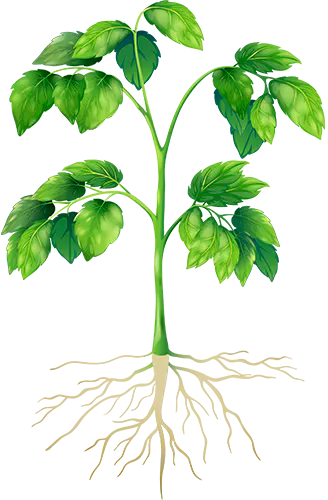
First, the plant's root network comes under strain precisely when it matters most. A well-developed root system is what absorbs water and nutrients from the soil, anchors the plant, protects it against weather, and stores energy for growth. When drought limits root development, that entire chain of function is compromised.
Second, the below-ground biology a plant depends on comes under the same pressure. Arbuscular mycorrhizal fungi (AMF) — which colonize more than 80% of land plants and function as an extension of the root system for water and nutrient uptake — are part of a broader microbial community that climate stress has been shown to suppress.
Third, the plant experiences cellular oxidative stress. Water deficit triggers physiological changes that produce reactive compounds inside plant tissue, and left unchecked, these can disrupt the plant's normal metabolic processes on top of the root and microbial strain described above.
Put together, a crop under water deficit is losing ground on multiple fronts at once: a root system that can't fully do its job, a microbial partnership that's been weakened right when the plant needs it most, and cellular oxidative stress that can disrupt normal metabolic function. Left unmanaged, that's the mechanism behind a compounding decline in the systems a plant relies on to stay productive.
This is where Acadian's Abiotic Stress Management (ASM) Prime portfolio – spanning both ST (seed treatment) and Drench soil-applied formats – takes a different starting point than most drought interventions: it works on these same systems before a plant is in crisis, not after.
Not every biostimulant gets there the same way. Acadian's newest ASM Prime formulations are purpose-built combinations, not a single extract working alone. Through a comprehensive screening process at Acadian's Formulation Centre of Excellence, active compounds are tested and optimized together to identify combinations that outperform any one ingredient applied by itself.
Acadian Plant Health biostimulants work with a crop's own defense systems by supporting the critical physiological functions a plant already relies on rather than introducing something foreign to its biology. Applied ahead of or early into a stress event, they help:
The logic is preventive rather than reactive: a plant whose root system, antioxidant defenses, and microbial partnerships are already supported enters a drought event in a stronger position, rather than needing to recover from it after the fact.
Critically, these effects are stronger in combination than in isolation. ST (seed treatment) — one of the first products launching within the ASM Prime portfolio — offers a direct example. Gene-expression research comparing the synergistic ST formulation to its individual active ingredients tested separately found that the combined formulation activated substantially more stress-response and photosynthesis-related genes than either active ingredient did on its own — direct evidence that formulating actives together, rather than applying them individually, is what drives the added performance.
The value of supporting a plant's stress response ahead of time shows up in measured outcomes. Seed Treatment is where that evidence base is most developed so far, and the trial data below is shared here as a representative example of how the product performs in the field. In efficacy trials under simulated drought — a 50% reduction in soil water capacity — ST-treated soybean seedlings showed stronger early growth than untreated plants. Under drought stress specifically, treated plants showed:
Those numbers matter because they represent exactly the mechanisms described above in action: a better-structured root system that helps the plant respond quickly to water and heat stress, keep growing through it, and avoid the kind of physiological disruption that turns into real productivity loss.
That synergy is measurable at the molecular level. In RNA-sequencing studies, corn and soybean treated with Acadian's combined seed treatment formulation showed 119 and 87 upregulated genes tied to photosynthesis and stress response, respectively — activity not replicated when the same crops were treated with either individual active ingredient alone. Efficacy trials back this up under real stress conditions: in soybean grown under a 50% reduction in soil water capacity, treated seedlings matched or exceeded the root length and emergence speed of unstressed, untreated plants, with shoot and root dry weight gains sustained across a range of application rates.
Acadian's Ascophyllum nodosum seaweed biostimulants have also been shown more broadly to improve resistance to environmental stresses including drought, heat, salinity, and cold, and to help crops maintain photosynthetic capacity and protect yield and quality when conditions work against them.
ASM Prime Drench (soil-applied) trials tell a similar story across a much wider range of crops — vegetables, small fruits, perennial and tropical crops — under hydric and salinity stress. Across dozens of field trials spanning multiple geographies, treated plants consistently showed stronger root development and better-protected yield:
The pattern holds consistently across crop types and stress conditions: root development and final yield are where ASM Prime Drench's benefit shows up, the same as ST — just measured across a broader set of crops and later growth stages.

For distributors building out the solutions growers rely on, there is a strong case for including abiotic stress management alongside pest and disease control.
Acadian's ASM Prime portfolio is designed to integrate within an existing program rather than replace it, backed by research that stands up to scrutiny, and grounded in a biological mechanism partners can explain with confidence to the growers they serve. The portfolio is coming to market first with Drench (soil-applied) and ST (seed treatment) to follow.
That distinction is what separates Acadian's ASM Prime formulations from a standalone extract: the performance gain comes from the specific combination of actives, validated at the gene-expression level and confirmed in the field, not simply from carrying a biostimulant product in the lineup.
Want to see how ASM Prime can fit into your product line? Let’s connect.